Publications
2027
-
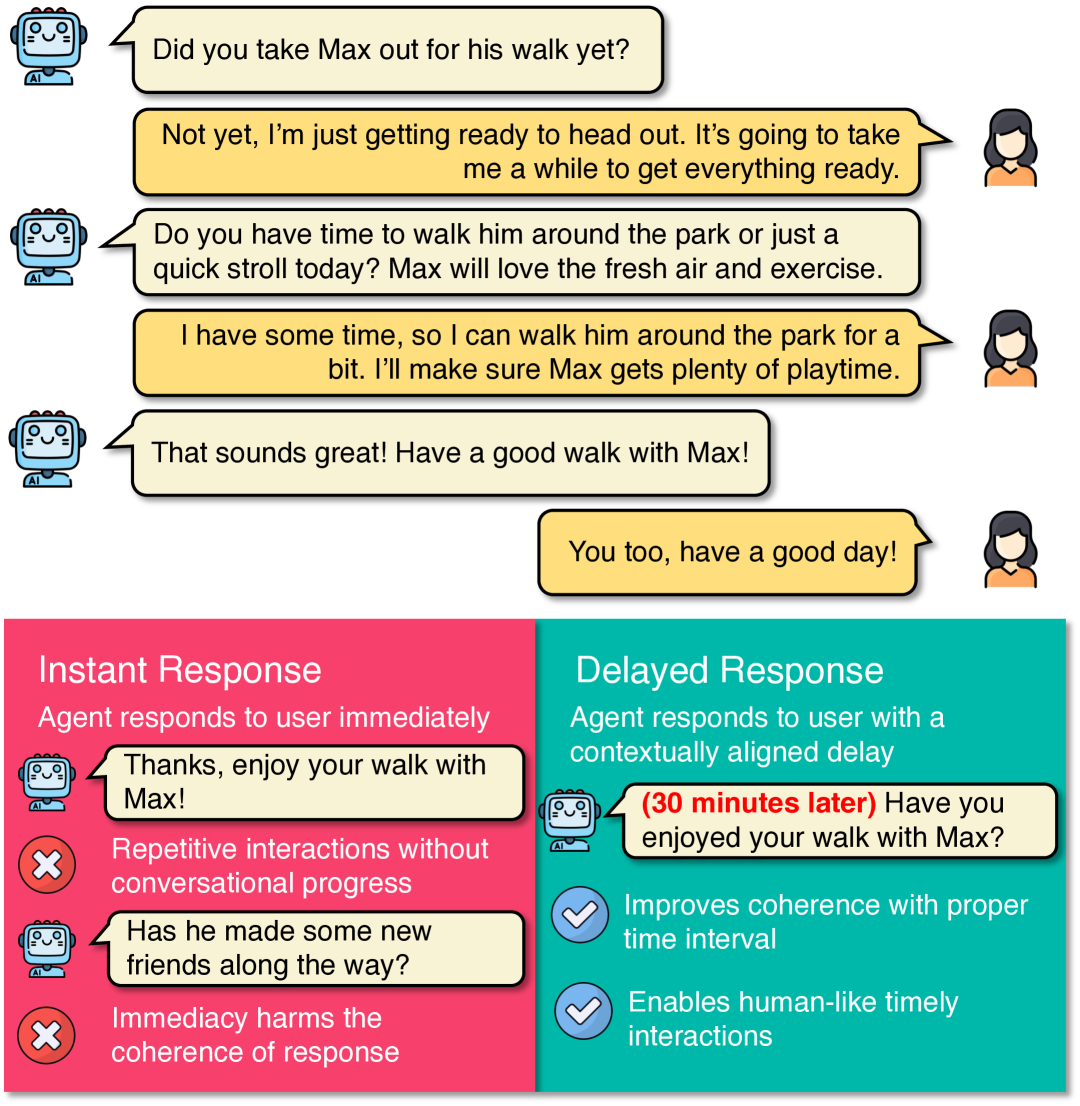
From What to Respond to When to Respond: Timely Response Generation for Open-Domain Dialogue Agents
Seongbo Jang, Minjin Jeon, Jaehoon Lee, Seonghyeon Lee, Dongha Lee, Hwanjo Yu
@article{jang-etal-2025-timelychat,
  area={social-intelligence},
  abbr={EACL Findings},
  title={From What to Respond to When to Respond: Timely Response Generation for Open-Domain Dialogue Agents},
  author={Seongbo Jang and Minjin Jeon and Jaehoon Lee and Seonghyeon Lee and Dongha Lee and Hwanjo Yu},
  journal={EACL Findings},
  year={2027},
  url={https://arxiv.org/abs/2506.14285},
  preview={/pub-previews/jang-etal-2025-timelychat.png},
  code={https://github.com/sb-jang/timelychat},
  abstract={While research on dialogue response generation has primarily focused on generating coherent responses conditioning on textual context, the critical question of when to respond grounded on the temporal context remains underexplored. To bridge this gap, we propose a novel task called timely dialogue response generation and introduce the TimelyChat benchmark, which evaluates the capabilities of language models to predict appropriate time intervals and generate time-conditioned responses. Additionally, we construct a large-scale training dataset by leveraging unlabeled event knowledge from a temporal commonsense knowledge graph and employing a large language model (LLM) to synthesize 55K event-driven dialogues. We then train Timer, a dialogue agent designed to proactively predict time intervals and generate timely responses that align with those intervals. Experimental results show that Timer outperforms prompting-based LLMs and other fine-tuned baselines in both turn-level and dialogue-level evaluations. We publicly release our data, model, and code.},
  selected={true},
}
2026
-
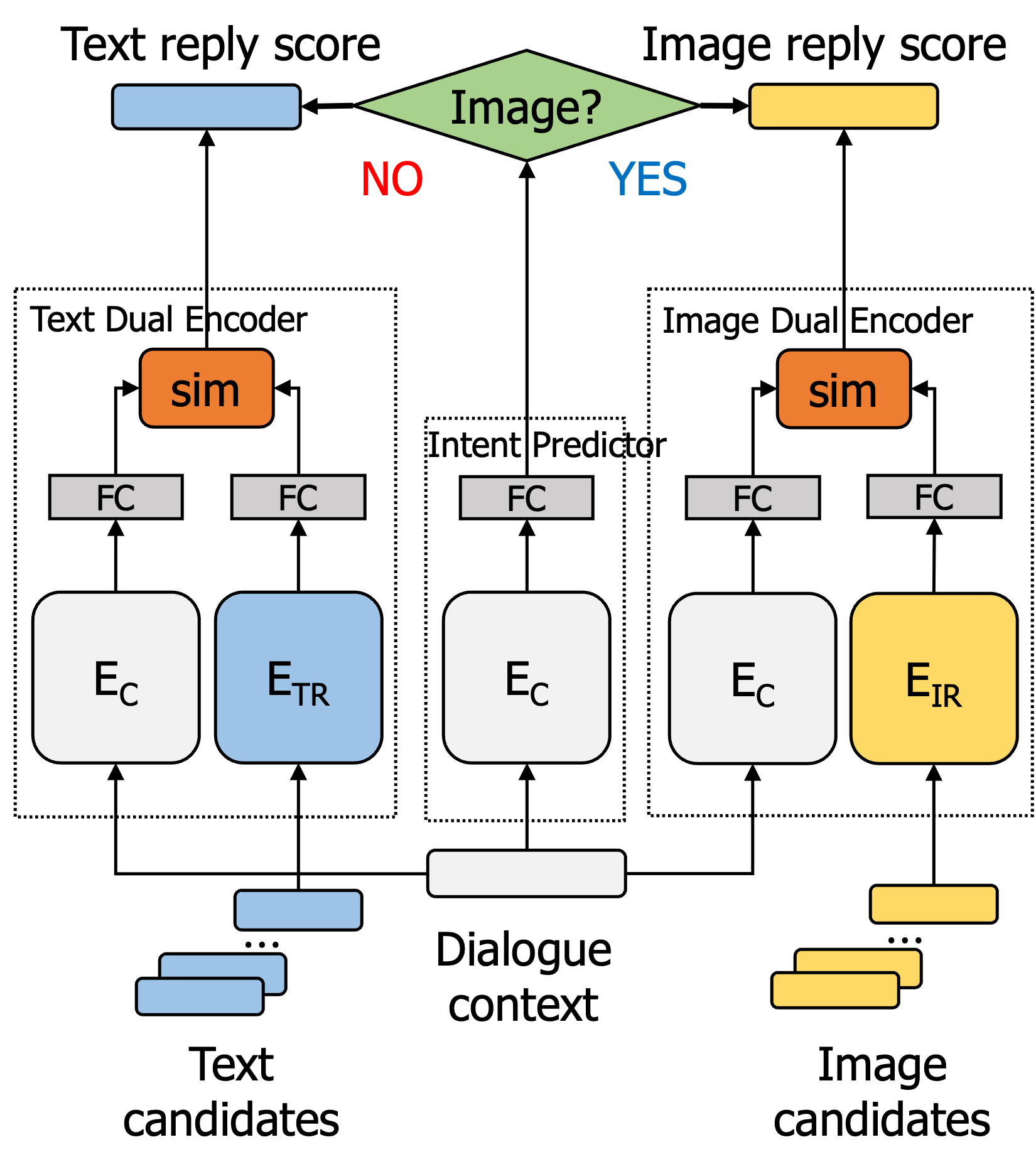
On the Effectiveness of Integration Methods for Multimodal Dialogue Response Retrieval
Seongbo Jang, Seonghyeon Lee, Dongha Lee, Hwanjo Yu
@article{jang-etal-2025-effectiveness,
  area={multimodal-lms},
  abbr={ICMR},
  title={On the Effectiveness of Integration Methods for Multimodal Dialogue Response Retrieval},
  author={Seongbo Jang and Seonghyeon Lee and Dongha Lee and Hwanjo Yu},
  journal={ICMR},
  year={2026},
  url={https://dl.acm.org/doi/10.1145/3805622.3810805},
  preview={/pub-previews/jang-etal-2025-effectiveness.png},
  abstract={Multimodal chatbots have become one of the major topics for dialogue systems in both research community and industry. Recently, researchers have shed light on the multimodality of responses as well as dialogue contexts. This work explores how a dialogue system can output responses in various modalities such as text and image. To this end, we first formulate a multimodal dialogue response retrieval task for retrieval-based systems as the combination of three subtasks. We then propose three integration methods based on a two-step approach and an end-to-end approach, and compare the merits and demerits of each method. Experimental results on two datasets demonstrate that the end-to-end approach achieves comparable performance without an intermediate step in the two-step approach. In addition, a parameter sharing strategy not only reduces the number of parameters but also boosts performance by transferring knowledge across the subtasks and the modalities.},
  selected={true},
}
2024
-
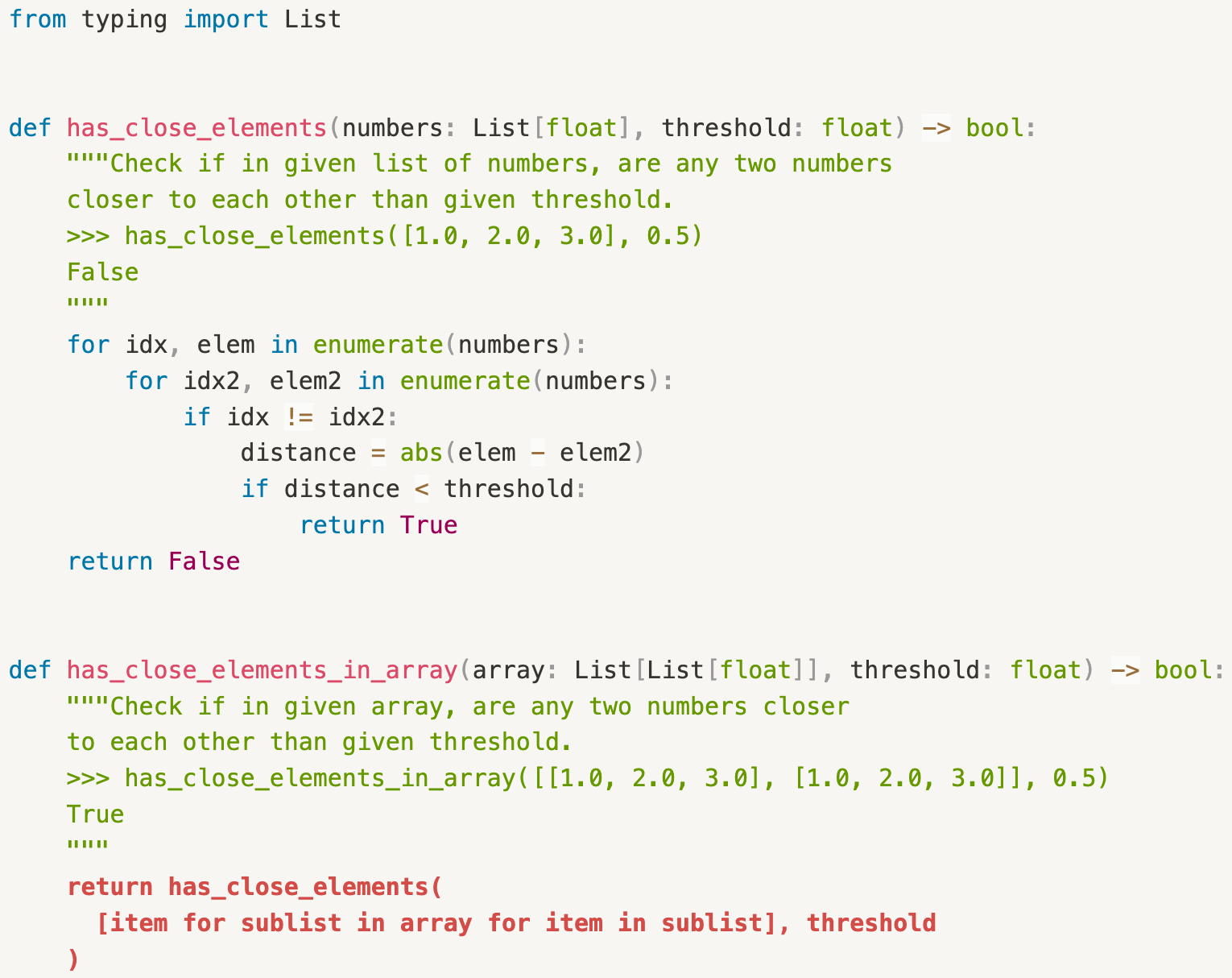
Exploring Language Model's Code Generation Ability with Auxiliary Functions
Seonghyeon Lee, Sanghwan Jang, Seongbo Jang, Dongha Lee, Hwanjo Yu
@article{lee-etal-2024-exploring, area={llm-evaluation}, abbr={NAACL Findings}, title={Exploring Language Model's Code Generation Ability with Auxiliary Functions}, author={Seonghyeon Lee and Sanghwan Jang and Seongbo Jang and Dongha Lee and Hwanjo Yu}, journal={NAACL Findings}, year={2024}, url={https://aclanthology.org/2024.findings-naacl.181/}, preview={/pub-previews/lee-etal-2024-exploring.png}, code={https://github.com/sh0416/humanextension}, abstract={Auxiliary function is a helpful component to improve language model's code generation ability. However, a systematic exploration of how they affect has yet to be done. In this work, we comprehensively evaluate the ability to utilize auxiliary functions encoded in recent code-pretrained language models. First, we construct a human-crafted evaluation set, called HumanExtension, which contains examples of two functions where one function assists the other. With HumanExtension, we design several experiments to examine their ability in a multifaceted way. Our evaluation processes enable a comprehensive understanding of including auxiliary functions in the prompt in terms of effectiveness and robustness. An additional implementation style analysis captures the models' various implementation patterns when they access the auxiliary function. Through this analysis, we discover the models' promising ability to utilize auxiliary functions including their self-improving behavior by implementing the two functions step-by-step. However, our analysis also reveals the model's underutilized behavior to call the auxiliary function, suggesting the future direction to enhance their implementation by eliciting the auxiliary function call ability encoded in the models. We release our code and dataset to facilitate this research direction.}, selected={true}, } -
KoDialogBench: Evaluating Conversational Understanding of Language Models with Korean Dialogue Benchmark
Seongbo Jang*, Seonghyeon Lee*, Hwanjo Yu
@article{jang-etal-2024-kodialogbench,
  area={social-intelligence, llm-evaluation},
  abbr={LREC-COLING},
  title={KoDialogBench: Evaluating Conversational Understanding of Language Models with {K}orean Dialogue Benchmark},
  author={Seongbo Jang* and Seonghyeon Lee* and Hwanjo Yu},
  journal={LREC-COLING},
  year={2024},
  url={https://aclanthology.org/2024.lrec-main.865/},
  code={https://github.com/sb-jang/kodialogbench},
  abstract={As language models are often deployed as chatbot assistants, it becomes a virtue for models to engage in conversations in a user's first language. While these models are trained on a wide range of languages, a comprehensive evaluation of their proficiency in low-resource languages such as Korean has been lacking. In this work, we introduce KoDialogBench, a benchmark designed to assess language models' conversational capabilities in Korean. To this end, we collect native Korean dialogues on daily topics from public sources, or translate dialogues from other languages. We then structure these conversations into diverse test datasets, spanning from dialogue comprehension to response selection tasks. Leveraging the proposed benchmark, we conduct extensive evaluations and analyses of various language models to measure a foundational understanding of Korean dialogues. Experimental results indicate that there exists significant room for improvement in models' conversation skills. Furthermore, our in-depth comparisons across different language models highlight the effectiveness of recent training techniques in enhancing conversational proficiency. We anticipate that KoDialogBench will promote the progress towards conversation-aware Korean language models.},
  selected={true},
}
2022
-
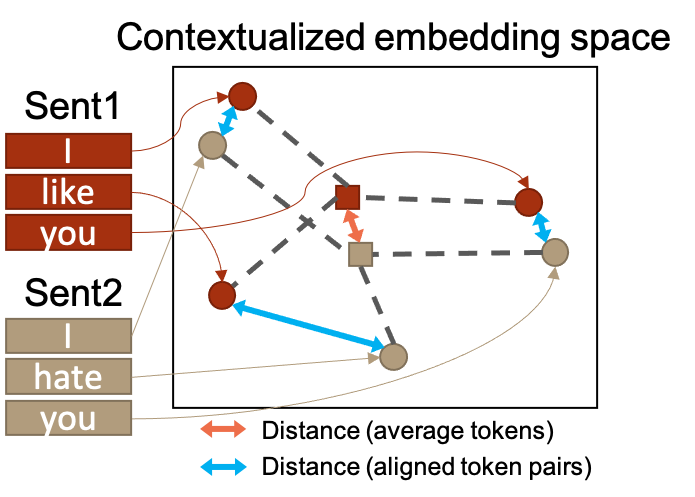
Toward Interpretable Semantic Textual Similarity via Optimal Transport-Based Contrastive Sentence Learning
Seonghyeon Lee, Dongha Lee, Seongbo Jang, Hwanjo Yu
@article{lee-etal-2022-toward,
  abbr={ACL},
  title={Toward Interpretable Semantic Textual Similarity via Optimal Transport-Based Contrastive Sentence Learning},
  author={Seonghyeon Lee and Dongha Lee and Seongbo Jang and Hwanjo Yu},
  journal={ACL},
  year={2022},
  url={https://aclanthology.org/2022.acl-long.412/},
  preview={/pub-previews/lee-etal-2022-toward.png},
  code={https://github.com/sh0416/clrcmd/},
  abstract={Recently, finetuning a pretrained language model to capture the similarity between sentence embeddings has shown the state-of-the-art performance on the semantic textual similarity (STS) task. However, the absence of an interpretation method for the sentence similarity makes it difficult to explain the model output. In this work, we explicitly describe the sentence distance as the weighted sum of contextualized token distances on the basis of a transportation problem, and then present the optimal transport-based distance measure, named RCMD; it identifies and leverages semantically-aligned token pairs. In the end, we propose CLRCMD, a contrastive learning framework that optimizes RCMD of sentence pairs, which enhances the quality of sentence similarity and their interpretation. Extensive experiments demonstrate that our learning framework outperforms other baselines on both STS and interpretable-STS benchmarks, indicating that it computes effective sentence similarity and also provides interpretation consistent with human judgement.},
  selected={true},
}
2021
-
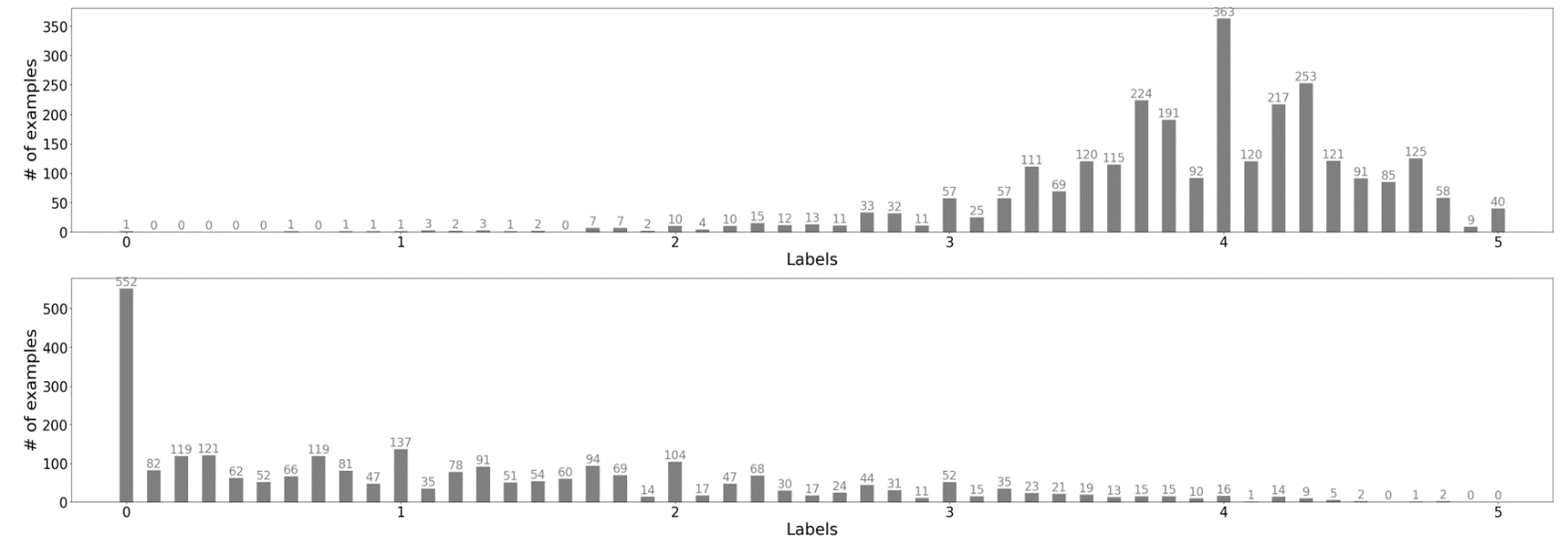
KLUE: Korean Language Understanding Evaluation
Sungjoon Park*, Jihyung Moon*, Sungdong Kim*, Won Ik Cho*, Ji Yoon Han, Jangwon Park, Chisung Song, Junseong Kim, Youngsook Song, Taehwan Oh, Joohong Lee, Juhyun Oh, Sungwon Lyu, Younghoon Jeong, Inkwon Lee, Sangwoo Seo, Dongjun Lee, Hyunwoo Kim, Myeonghwa Lee, Seongbo Jang, Seungwon Do, Sunkyoung Kim, Kyungtae Lim, Jongwon Lee, Kyumin Park, Jamin Shin, Seonghyun Kim, Lucy Park, Alice Oh**, Jung-Woo Ha**, Kyunghyun Cho**
@article{park-etal-2021-klue,
  area={llm-evaluation},
  abbr={NeurIPS Datasets and Benchmarks},
  title={KLUE: Korean Language Understanding Evaluation},
  author={Sungjoon Park* and Jihyung Moon* and Sungdong Kim* and Won Ik Cho* and Ji Yoon Han and Jangwon Park and Chisung Song and Junseong Kim and Youngsook Song and Taehwan Oh and Joohong Lee and Juhyun Oh and Sungwon Lyu and Younghoon Jeong and Inkwon Lee and Sangwoo Seo and Dongjun Lee and Hyunwoo Kim and Myeonghwa Lee and Seongbo Jang and Seungwon Do and Sunkyoung Kim and Kyungtae Lim and Jongwon Lee and Kyumin Park and Jamin Shin and Seonghyun Kim and Lucy Park and Alice Oh** and Jung-Woo Ha** and Kyunghyun Cho**},
  journal={NeurIPS Datasets and Benchmarks},
  year={2021},
  url={https://datasets-benchmarks-proceedings.neurips.cc/paper/2021/hash/98dce83da57b0395e163467c9dae521b-Abstract-round2.html},
  code={https://github.com/KLUE-benchmark/KLUE},
  website={https://klue-benchmark.com},
  preview={/pub-previews/park-etal-2021-klue.png},
  abstract={We introduce Korean Language Understanding Evaluation (KLUE) benchmark. KLUE is a collection of eight Korean natural language understanding (NLU) tasks, including Topic Classification, Semantic Textual Similarity, Natural Language Inference, Named Entity Recognition, Relation Extraction, Dependency Parsing, Machine Reading Comprehension, and Dialogue State Tracking. We create all of the datasets from scratch in a principled way. We design the tasks to have diverse formats and each task to be built upon various source corpora that respect copyrights. Also, we propose suitable evaluation metrics and organize annotation protocols in a way to ensure quality. To prevent ethical risks in KLUE, we proactively remove examples reflecting social biases, containing toxic content or personally identifiable information (PII). Along with the benchmark datasets, we release pre-trained language models (PLM) for Korean, KLUE-BERT and KLUE-RoBERTa.},
  selected={true},
}
2020
-
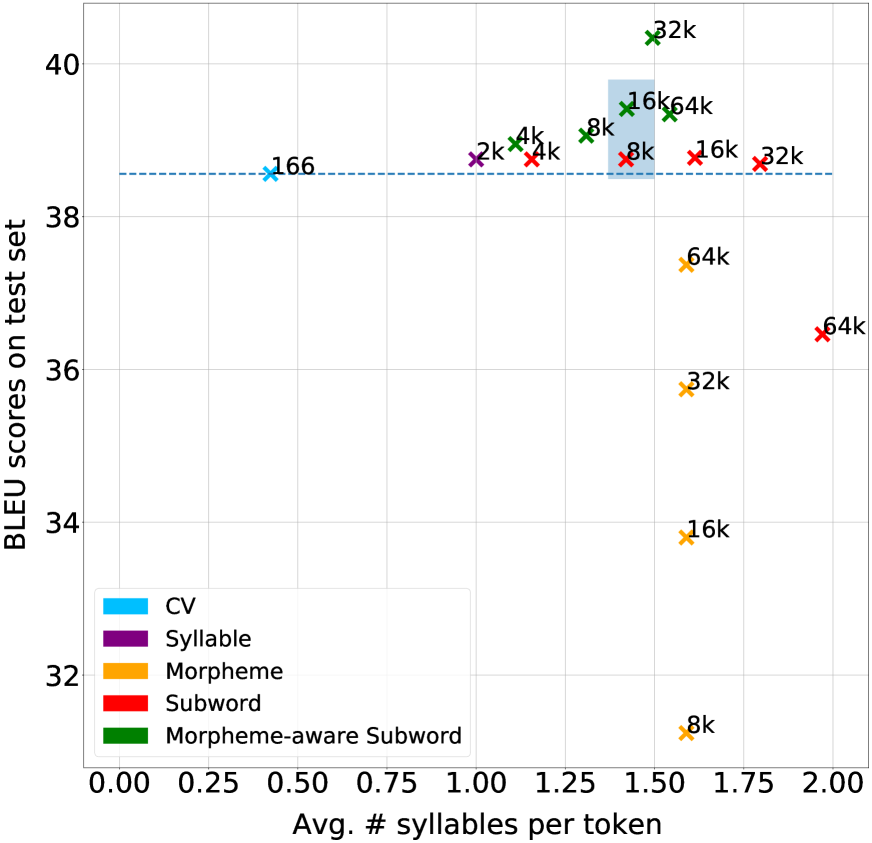
An Empirical Study of Tokenization Strategies for Various Korean NLP Tasks
Kyubyong Park*, Joohong Lee*, Seongbo Jang*, Dawoon Jung*
@article{park-etal-2020-empirical, area={llm-evaluation}, abbr={AACL-IJCNLP}, title={An Empirical Study of Tokenization Strategies for Various Korean NLP Tasks}, author={Kyubyong Park* and Joohong Lee* and Seongbo Jang* and Dawoon Jung*}, journal={AACL-IJCNLP}, year={2020}, url={https://aclanthology.org/2020.aacl-main.17/}, preview={/pub-previews/park-etal-2020-empirical.png}, code={https://github.com/kakaobrain/kortok}, abstract={Typically, tokenization is the very first step in most text processing works. As a token serves as an atomic unit that embeds the contextual information of text, how to define a token plays a decisive role in the performance of a model. Even though Byte Pair Encoding (BPE) has been considered the de facto standard tokenization method due to its simplicity and universality, it still remains unclear whether BPE works best across all languages and tasks. In this paper, we test several tokenization strategies in order to answer our primary research question, that is, "What is the best tokenization strategy for Korean NLP tasks?" Experimental results demonstrate that a hybrid approach of morphological segmentation followed by BPE works best in Korean to/from English machine translation and natural language understanding tasks such as KorNLI, KorSTS, NSMC, and PAWS-X. As an exception, for KorQuAD, the Korean extension of SQuAD, BPE segmentation turns out to be the most effective. Our code and pre-trained models are publicly available at https://github.com/kakaobrain/kortok.}, selected={true}, } -
Input Initialization for Inversion of Neural Networks Using k-Nearest Neighbor Approach
Seongbo Jang, Ye-Eun Jang, Young-Jin Kim, Hwanjo Yu
@article{jang-etal-2020-input,
  abbr={Information Sciences},
  title={Input Initialization for Inversion of Neural Networks Using k-Nearest Neighbor Approach},
  author={Seongbo Jang and Ye-Eun Jang and Young-Jin Kim and Hwanjo Yu},
  journal={Information Sciences},
  year={2020},
  url={https://www.sciencedirect.com/science/article/pii/S0020025520300426},
  abstract={Inversion of neural networks aims to find optimal input variables given a target output, and is widely applicable in an industrial field such as optimizing control variables of complex systems in manufacturing facilities. To achieve optimal inputs using a standard first-order optimization technique, proper initialization of input variables is essential. This paper presents a new initialization method for input variables of neural networks based on k-nearest neighbor (k-NN) approach. The proposed method finds inputs which resulted in an output close to a target output in a training dataset, and combine them to form initial input variables. Experiments on a toy dataset demonstrate that our method outperforms random initialization. Also, we introduce an exhaustive case study on power scheduling of a heating, ventilation, and air conditioning (HVAC) system in a building to support the effectiveness of the algorithm.},
  selected={true},
}